Home > News > The La Doua Campus before CETIAT: from a military training ground to an innovation hub
The La Doua Campus before CETIAT: from a military training ground to an innovation hub
Although CETIAT is now firmly established at the heart of the La Doua campus, the site has a rich and often little-known history dating back well before 1970.
To mark its 65th anniversary, CETIAT looks back at the origins of its establishment and the major transformations that have taken place in this region, which has become a major scientific hub.
From pasture to training ground
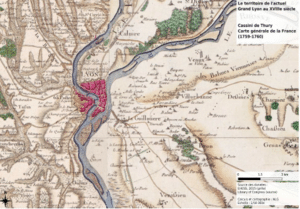
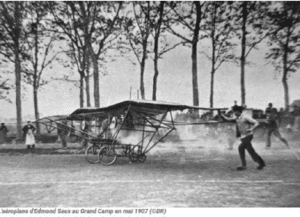
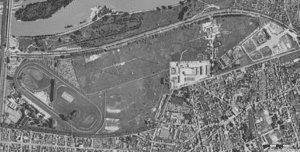
CASSINI MapPoster held at the Gadagne MuseumEdmond Seux’s aeroplane, 1907
As early as the 17th century, the Villeurbanne plain was known for its communal pastures, where livestock grazed freely.
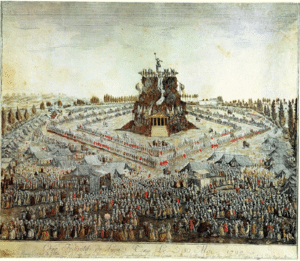
In 1790, the site hosted a massive Federal Camp, bringing together 100,000 people united by the ideals of the Revolution.
Very quickly, the area became a military training ground, then a racecourse (1867), and even a site for aeronautical experiments during the Belle Époque, where Lyon’s first powered flights took to the skies.
A strategic communication platform
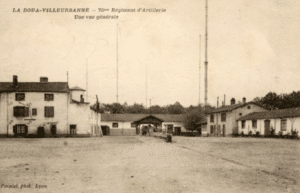
Antennas as seen from the barracks (circa 1930)Aerial photograph of the cemetery (circa 1954)
In 1914, against a backdrop of international tensions, the site was chosen to house a strategic radio telegraphy station, equipped with pylons reaching a height of 200 metres.
From there, France communicates with America, the USSR and its colonies.
During the Second World War, the site was occupied, bombed, and then partially rebuilt after 1945.
In 1954, it also became the memorial site that is now known as the La Doua National Necropolis.
From military discipline to scientific rigour
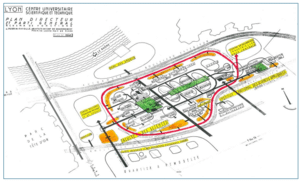
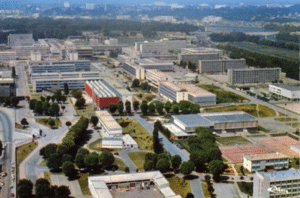
Masterplan for the development of the Doua site by architect Jacques Perrin-FayolleLa Doua around 1975: on the right, you can see the CETIAT’s Building A, which had recently been built
With the establishment of INSA Lyon in 1957, followed by the University of Claude Bernard, La Doua began its transformation into a scientific hub.
The construction of Building A at CETIAT in 1970 marked the start of a new chapter, dedicated to measurement, precision and supporting manufacturers.
Lyon Society for the History of Aviation and Aeronautical Documentation (SLHADA)
You might find this interesting
News
Expert advice – Making the most of waste heat: what are the key steps in the process?
Lauriane GIROUD, a research officer at CETIAT, outlines the three key stages involved in structuring a waste heat recovery project, from identifying heat flows to selecting technical and financial solutions.
News
The ventilation, refrigeration and heating sector: a sector that drives innovation
CETIAT contributes to the overview of the ventilation, refrigeration and heating sector in Auvergne-Rhône-Alpes, published by Auvergne-Rhône-Alpes Entreprises.
News
Carnot MECD Institute: CETIAT joins the network
CETIAT has joined the Carnot MECD Institute to strengthen collaboration and pool expertise on issues relating to sustainable construction.
News
Standalone air purifiers: CETIAT publishes an installation guide
CETIAT has published a new guidance sheet on stand-alone air purifiers. Find out about best practice for installing them on the premises.